

Netanyahu’s Legacy
Regardless of whether an agreement with Iran is reached, I stand by this piece.

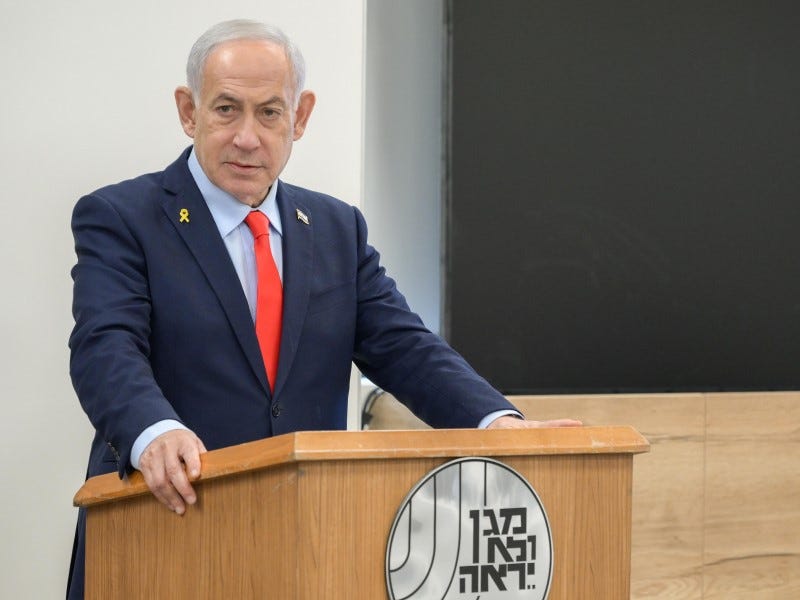
I’m writing these lines before a U.S. agreement with Iran has been finalized. As things stand, it looks like capitulation.
Let us though take a step back to understand how we got here. A long step back.
Zionism is defined as a nationalist movement for the creation of a Jewish state in the Land of Israel. As a narrow, political definition, it works. But Zionism is, or rather was, more than just a political movement. It also carried with it an ethical substance.
Recall that Zionism was birthed in Europe, at a time when Jews became disillusioned from the promises of emancipation. They realized—or at least a portion of them realized—that the promise of equal rights for all, no matter one’s religion, race or sex, was fleeting. A journalist named Theodor Herzl envisioned a solution in the form of a sovereign, independent state, where Jews could live the lives of free men and women, without someone else’s permission. This was the implicit moral message of Zionism.
Whatever the specific politics of the various Zionist sections (and they held a conglomerate of contradictory views), they all held one common goal: the formation of an independent state, where Jews can independently decide how to live their independent lives. Zionism bore the promise of taking one’s fate in his own hands.
Zionism in this regard was a product of the Enlightenment, even as the Enlightenment was crumbling to pieces in Europe.
Zionism’s virtue of independence is the root that inspired its members to overcome the challenges they faced: from building a modern, functioning society on barren lands to fending off seven invading armies in the War of Independence.
The nascent Jewish state did not necessarily advance genius military strategy in its formative years, but it nevertheless took initiative and did not sit on its laurels, waiting for the enemy to act. From dispatching elite squadrons against the Fedayeen in the 50s, to preparing for military victory in the 60s, to conquering Beirut in 1982. Some actions resulted in failure, but Israelis always took matters into their own hands. This was the principle that guided Israel in the first decades of its existence. It never relinquished its independence or dared subordinate it to others. On the contrary, independence was maintained with zeal.
But then came the late 80s and a new intellectual movement started to dominate the intellectual sphere in Israel; from the corridors of the academic world to the highest echelons in government. This movement sought to take a new kind of initiative—to build a state for the enemy. This was somewhat paradoxical: using Israel’s independence to willfully create a dependent Palestinian state at its own independent’s expense.
It was like taking an obligation that by default diminishes one’s freedom of action.
Some obligations are manifestations of independence. For example, taking responsibility in a business enterprise. Or choosing to bring children into the world and raising them until adulthood. But these obligations are rewarded through reciprocal values. Obligations that bind toward a goal with no value in return are chains. And this was the manipulation of the Oslo proponents: they promised the value of peace in return for Israel’s sacrifice.
Israelis thought they were taking initiative to gain value. In truth they were giving away their independence, betraying the core virtue of Zionism.
The reality of this betrayal exploded throughout the 90s and with greater force in the Second Intifada. Israelis learned the hard way that the promise of peace was a nightmare. Ultimately, they rejected its utopian vision.
But this rejection came at a cost. Israelis ended up rejecting any promise of a positive future. The rejection of peace was only the tip of the iceberg. The Israelis now fully embraced the antithesis of Zionism: surrender.
The Israelis surrendered their independence.
They were angry at the Oslo Accords, but never cancelled it. They were angry at Palestinians, but resigned to accept their violence. They were angry at the Left, but never offered any alternative. And into the void stepped Benjamin Netanyahu. Netanyahu was the perfect escape for the Reactionary Right. He was coherent, clever, knew how to argue against the Leftist talking points. But when you peeled off these cosmetics the revealed essence was nil.
There is a sense in which the Oslo process was a dangerous shrugging of independence, but at least the danger was out in the open. The death trap that Israel was throwing itself into was clear for all to see. But with Netanyahu we had a case where the danger was not clear. This danger was: a principled rejection of independence.
Netanyahu throughout his tenure as prime minister in principle did not make decisions, did not act, did not initiate, did not stand on principles—did not stand for anything. And not just in foreign policy. This was a feature in every realm under his “leadership.” His modus operandi was to wait until a particular external pressure prevails over the rest and only then announce a particular decision. If no competing forces object, then no risk is involved. If competing forces do object, each pulling in a different direction, Netanyahu lets them play it out until one party wins and he has no option but to go along with the “inevitable” result. If his fans are disappointed, they say: “he tried, but others didn’t let him.” If his fans are pleased, he takes the credit. In practice, he does not lead anywhere.
In foreign policy, Netanyahu said he will “manage the conflict,” which translates to doing nothing but respond to events. The independent force of Zionism ceased to be. Israel’s enemies in Judea and Samaria, the Gaza Strip, Lebanon, Yemen and Iran took the que and began initiating a serious plot for the destruction of the Jewish state.
This is how October 7th came to be. And what could Netanyahu do once the illusion of Mr. Security burst in one foul day through the bodies of 1,200 victims and counting? He has never initiated policies, he has not strategized, he has not led in principle nor did he stand for anything other than political power. Even if he wanted to lead now, he would not know how. Twenty years of rejecting independence in principle cannot yield leadership out of nowhere. Netanyahu’s inaction as a life’s motto came back to bite him.
Take now a broader view of where Israel stands today. The front in Gaza has been handed over to the Americans. Netanyahu can’t go to war with Gaza without first receiving Washington’s approval.
In Iran, Netanyahu bound his country’s fate to foreign powers again. He went “all in” with President Trump—a juvenile buffoon—forgetting that one does not receive assistance without having to give something in return. With the type of man in the White House, that thing in return was subordination to whim. Now not only is Netanyahu shackled versus Iran, but he is also shackled in Lebanon.
In other words, as we approach elections in October, Netanyahu is close to finishing the war that started almost three years ago with a second Palestinian state in Gaza, a relentless and vengeful militia to Israel’s north, and an empowered Iran that will be able to impose its will on the region without the crippling effect of U.S. sanctions. After facing off “Big and Little Satan” together, the Islamic Republic will feel that Allah is with it more than ever before, boosting its motivation to rush to a bomb without hesitation.
Yahya Sinwar, the mastermind of October 7th, elaborated that the overarching strategy of the atrocious attack was to prompt a perpetual multi-front war against Israel that would ultimately lead to its annihilation. Sinwar may be dead, but his strategy is still unfolding as I write these lines.
Whether the hostilities end or not in the coming days will not put a dent to Hamas’s grand strategy. The fact that Israel today has effectively surrendered the core promise of Zionism means that its fate is no longer in its hands. Unless something truly unexpected happens in October, I don’t see where a fundamental change comes from.
* * *
You might have one lingering question on your mind. What does Netanyahu get from rejecting independence? In his case, the answer is power. Netanyahu might have started his political career with some ideals, but all that is left of him today is an empty shell with a lust for power.
In this sense, Netanyahu is the embodiment of anti-Zionism. Not in the narrow sense of opposing the existence of a Jewish state, but in the broader, ethical implication of Zionism. The man who seeks nothing but to rule for ruling’s sake is the ultimate slave. The ruler who depends on his subjects does not know the meaning of independence.
Netanyahu of course is only a symptom of the problem, but this does not absolve him (or his followers) from his direct responsibility for the country’s present woes.
Ayn Rand once said that between the Red Army and the White Army, the latter was worse. The advocate of laissez-faire capitalism was no friend of communists of course, but at least the Red Army stood for something, she said. The White Army stood for nothing. This is Netanyahu. This is his legacy.
☞
If you enjoyed this piece, hit the like button and share. It helps spreading the message. Mr Examiner is urging you to do it!